
This article contains affiliate links. We may earn a commission from qualifying purchases.
Some content on this site is AI-assisted and reviewed by our editorial team.
https://coloredcalm.com/coloring-for-focus-adhd/
Coloring for Focus and ADHD: How Structured Coloring Helps You Concentrate

You know that feeling when your brain has seventeen tabs open and someone keeps hitting refresh on all of them? That’s what living with ADHD, or just chronic distractibility, feels like. Your mind races, your hands fidget, and focusing on one thing for more than five minutes seems about as realistic as teaching a cat to fetch.
Disclosure: As an Amazon Associate, ColoredCalm earns from qualifying purchases. This post contains affiliate links, which means we may earn a commission if you click through and make a purchase, at no additional cost to you.
Here’s what most people don’t realize: coloring might be one of the simplest, most accessible tools for managing that scattered energy. Not as a cure. Not as a replacement for medication or therapy. But as a genuine, evidence-supported practice that gives your brain something concrete to anchor to when it wants to drift.
I have a mandala coloring book on my desk and whenever I catch myself switching between five tabs without reading any of them, I flip it open and color for fifteen minutes. It resets my attention every single time.
This guide covers why structured coloring helps with focus and ADHD, what the research actually shows, and how to build a coloring practice that works for your brain, not against it.
Why ADHD Brains Struggle With Focus (And Why Coloring Helps)
ADHD isn’t about a lack of attention. It’s about difficulty directing attention. Your brain has plenty of focus, it just applies it unevenly. You might hyperfocus on something fascinating for three hours straight but can’t spend ten minutes on a task that feels boring or overwhelming.
This happens because ADHD brains have lower baseline levels of dopamine, the neurotransmitter that drives motivation and reward-seeking behavior. When a task doesn’t provide enough stimulation, your brain goes looking for something that will. That’s why you pick up your phone, check the fridge, reorganize your desk, anything to get a small dopamine hit.
Coloring works because it hits a sweet spot:
- Structured but not rigid. You have boundaries (stay in the lines) but creative freedom (pick any color). This gives your brain just enough constraint to stay engaged without feeling trapped.
- Low stakes, There’s no “wrong” way to color. No deadline. No one grading you. The pressure that usually makes ADHD brains freeze up simply doesn’t exist.
- Tactile and visual, Coloring engages multiple senses at once: the feel of the pencil on paper, the visual feedback of color filling in, the physical motion of your hand. This multisensory engagement is exactly what ADHD brains crave.
- Dopamine from completion, Each small section you finish gives your brain a tiny reward. Fill in a petal. Done. Fill in a leaf. Done. These micro-completions provide the dopamine hits your brain is searching for, without requiring a phone or social media scroll.
What the Research Actually Says
Let’s be clear: coloring is not a treatment for ADHD. No responsible clinician would suggest replacing medication or therapy with a coloring book. But the research on structured art activities and attention is genuinely promising.
Key findings:
- A 2021 study published in the Journal of Attention Disorders found that structured art activities (including coloring) significantly improved sustained attention in adults with ADHD compared to unstructured free-drawing
- Research from Frontiers in Psychology showed that 20 minutes of mandala coloring improved executive function, the brain’s ability to plan, organize, and shift between tasks, in participants with attention difficulties
- A 2019 study in the International Journal of Art Therapy found that coloring reduced mind-wandering episodes by roughly 40% during and immediately after the activity
- Occupational therapists have used coloring as a fine motor and focus-building activity for children with ADHD for decades, the adult application follows the same neurological principles
What this means in practice: Coloring won’t “fix” ADHD. But it can give you a 20-to-30-minute window of calmer, more directed attention, and that window can be incredibly valuable, whether you use it to decompress after work, transition between tasks, or prepare your brain for something that requires concentration.
The Type of Coloring That Actually Helps Focus
Not all coloring works the same way for attention. Here’s what works and what doesn’t:
What Works: Structured, Detailed Designs
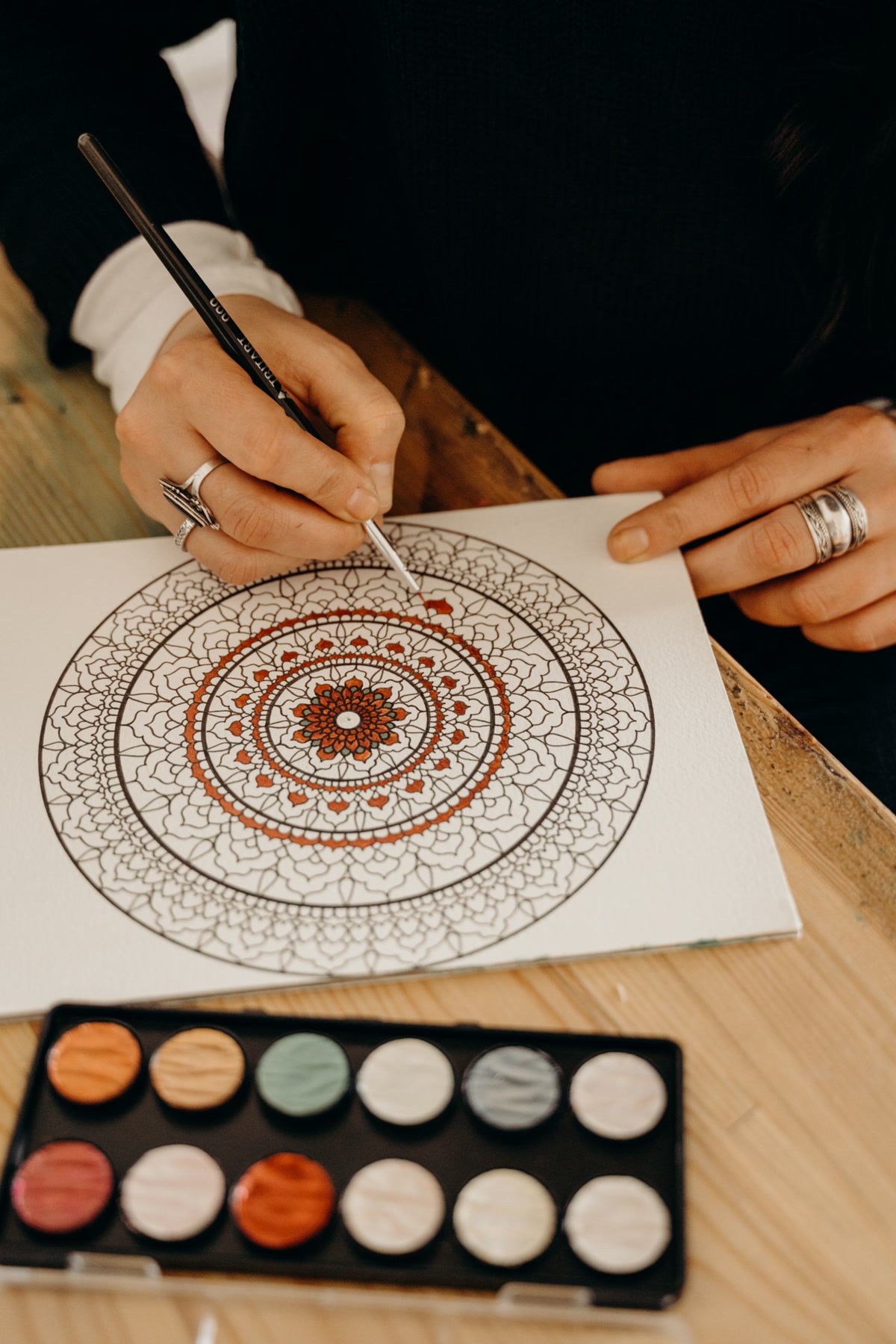
Mandalas are the gold standard for focus. The circular, repeating patterns engage your brain’s pattern-recognition circuits without overstimulating them. Start with simpler mandalas and work up to more complex ones. Try Creative Haven Creative Cats, the repeating cat motifs provide the same pattern-based focus benefits as mandalas, with a fun twist.
Geometric patterns work similarly. Tessellations, Islamic art-inspired designs, and repetitive shape-based pages all engage the same attention-stabilizing circuits.
Nature scenes with clear sections, flowers with distinct petals, trees with individual leaves, butterflies with separate wing segments, give your brain natural boundaries to work within. Each section is a mini-task to complete. Secret Garden by Johanna Basford is perfect for this, detailed enough to hold attention, sectioned enough to give your brain those completion rewards.
What Doesn’t Work: Free Drawing and Open-Ended Art
When your brain is already struggling to direct attention, giving it a blank page is like handing a compass to someone in a featureless desert. There’s nothing to orient toward. Free drawing and doodling can be great for creative expression, but they require the executive function skills, planning, initiating, sustaining, that ADHD brains are already short on.
Skip the blank pages. Give your brain something to work with.
The Sweet Spot: Medium Complexity
Too simple (large shapes, thick lines) and your brain gets bored. Too complex (microscopic details, overlapping patterns with no clear sections) and your brain gets overwhelmed. You want designs that are detailed enough to require attention but not so intricate that they cause frustration.
Rule of thumb: If you can clearly see 5-10 distinct sections on a page without squinting, it’s in the right range. If every section looks like it requires a magnifying glass, save it for a good focus day.
How to Build a Focus Coloring Practice
The 15-Minute Reset
This is the simplest way to start. When you feel your attention fragmenting, you’ve re-read the same paragraph three times, you’re switching between five tabs, or you catch yourself doom-scrolling, try this:
- Close whatever you’re struggling with
- Open your coloring book to a page you’ve already started
- Set a timer for 15 minutes
- Color until the timer goes off
- Return to your original task
The coloring session acts as a palate cleanser for your brain. It’s not逃避 (avoidance), it’s a deliberate reset that gives your attention circuits a chance to recalibrate. Many people find they return to their task with noticeably better focus after even a short coloring break.

The Task Transition
ADHD brains struggle with task-switching. When you finish one thing and need to start another, there’s often a dead zone where you stall out, get distracted, or procrastinate. Coloring can bridge that gap.
How it works: Instead of going directly from Task A to Task B, insert a 10-minute coloring session between them. The structured activity gives your brain time to disengage from the first task and prepare for the second, without the unstructured downtime that leads to distraction.
The Pre-Focus Warmup
Before sitting down to do something that requires sustained attention, studying, writing, working on a project, spend 10-15 minutes coloring. Think of it like stretching before exercise: you’re warming up the attention circuits you’re about to use.
Pro tip: Choose a page that’s partially complete rather than starting a new one. The partial completion gives your brain immediate small wins (filling in that next petal, finishing that one section) without the executive function demand of choosing where to begin.
The Evening Wind-Down
Many people with ADHD struggle with “revenge bedtime procrastination”, staying up late because you didn’t get enough done during the day. Coloring before bed can help break this cycle by giving your brain a structured, low-stimulation activity that doesn’t involve screens.
Use calming colors (blues, greens, soft purples) and stick to designs you’ve already started. The goal isn’t to create something beautiful, it’s to give your brain something to do that isn’t “think about everything you should have done today.”

For more on the bedtime benefits of coloring, see our guide on coloring for sleep.
Best Supplies for Focus Coloring
When you’re coloring specifically for focus and attention management, your supply choices matter more than you might think.
Colored Pencils: The Focus Tool
Colored pencils are the best choice for focus coloring because they require more deliberate, controlled movement than markers or gel pens. That extra physical engagement is actually an advantage, it keeps more of your nervous system involved in the activity, which means less available bandwidth for distraction.
Top picks:
- Prismacolor Premier, Soft, rich pigment that fills in smoothly. The buttery laydown means less physical effort, which helps when you’re already tired. Ideal for medium to detailed work.
- Faber-Castell Polychromos, Harder lead holds a point longer, which is great for precision work in detailed designs. If tight spaces and fine lines help you focus, these are your pencils.
- Arteza Professional, Solid quality at a lower price point. Good if you’re just trying focus coloring and don’t want to invest heavily. See our best colored pencils under 50 dollars guide for a deeper comparison.
Keep Your Pencils Sharp
A dull pencil makes coloring harder and more frustrating than it needs to be, and frustration is the enemy of focus. Invest in a good sharpener.
Kum Long Point Sharpener. The two-hole design gives you a choice between a standard point and a long point. The long point is ideal for detailed work because it lasts longer before needing resharpening. Read our full pencil sharpener guide for more options.
Coloring Books for Focus
Choose books with clear, repeating sections and medium-to-high detail:
- Secret Garden by Johanna Basford, Nature designs with distinct sections. Excellent for the section-by-section completion approach.
- Creative Haven Creative Cats, Repeating patterns with a playful element. The cat theme adds a fun factor that keeps the dopamine flowing.
- Worlds of Wonder, Intricate but sectioned designs that reward sustained attention without overwhelming.
For more recommendations, check our best adult coloring books for 2026 and our beginner-friendly picks.
Common Mistakes That Kill the Focus Benefit
1. Trying to Be Perfect
Perfectionism and focus don’t mix. If you’re obsessing over staying perfectly inside the lines, you’re introducing stress, the very thing coloring is supposed to reduce. Let it be messy. Color outside the lines sometimes. The focus benefit comes from the process, not the result.
2. Choosing Pages That Are Too Complex
There’s a temptation to pick the most intricate, challenging page in the book. Resist it. Overly complex pages demand too much executive function at once, deciding colors, planning sections, maintaining precision. Start with medium complexity and work your way up.
3. Coloring for Too Long
A 20-minute coloring session can sharpen focus. A two-hour session can leave you zoning out. Pay attention to your attention, when you notice your mind starting to wander despite the coloring, it’s time to stop and move on.
4. Using Screens While Coloring
The whole point is to give your brain a break from digital stimulation. Watching YouTube or scrolling Instagram while you color defeats the purpose. If you need background noise, try instrumental music or a white noise app, something that doesn’t demand your visual attention.
Coloring + ADHD Medication: A Complementary Approach
If you take medication for ADHD, coloring can be a valuable complement. Here’s how:
- During medication onset, Many people feel a “ramp up” period when their medication starts working. Coloring during this 20-30 minute window gives you something structured to do while you wait.
- During medication wear-off, As your medication wears off, the transition can feel jarring. Coloring can smooth that transition by giving your brain a structured activity during the dip.
- On medication holidays, Days when you don’t take medication can feel particularly scattered. A focus coloring session can provide some of the structure that medication normally supplies.
Always follow your doctor’s guidance. Coloring is a support tool, not a replacement for any prescribed treatment.
When Coloring for Focus Isn’t Enough
Coloring is one tool in a toolkit. It’s not the whole toolkit. If you’re struggling with focus and haven’t talked to a professional, consider it. ADHD is a real neurological condition, not a character flaw, and there are effective treatments available.
Signs that coloring alone isn’t sufficient:
- You can’t focus long enough to color for more than 2-3 minutes
- Your attention issues are significantly impacting your work, relationships, or daily functioning
- You feel frustrated rather than calmed by structured activities
- You’re using coloring to avoid dealing with other problems
A therapist who specializes in ADHD can help you develop a comprehensive approach that might include medication, cognitive behavioral strategies, and yes, creative practices like coloring.
For more on the mental health benefits of coloring, see our guides on coloring for anxiety and how coloring reduces stress.
The Bottom Line
Coloring for focus works because it gives your brain exactly what it’s asking for: structured stimulation, manageable tasks, and small dopamine rewards. It’s not magic, and it’s not a replacement for professional support. But as a 15-minute reset between tasks, a warmup before focused work, or a way to transition out of a scattered state, it’s one of the most accessible and effective tools available.
Start simple. Get one book and one set of pencils. Try the 15-minute reset for a week. Pay attention to how your brain feels before, during, and after. You might be surprised at how much a structured, colorful break can do.
n
Read unlimited books? With Kindle Unlimited, read as much as you want from 4M+ titles, including thousands of coloring and art books. Try Kindle Unlimited FREE for 2 months
Bottom Line
Structured coloring can help with focus and ADHD by giving the brain a clear, manageable task. What really matters is choosing the right complexity level, not too simple and not too intricate. Consistency matters more than session length.
🎨 Get Your Free Stress Relief Coloring Guide
Join our newsletter and get this free printable plus weekly tips.