This article contains affiliate links. We may earn a commission from qualifying purchases.
Some content on this site is AI-assisted and reviewed by our editorial team.
If you have ever layered a rich sienna over a light peach, watched it go down beautifully for about three passes, and then had the paper simply refuse to take any more pigment, you have met the paper ceiling. Nothing is wrong with your pencils or your technique — your paper ran out of tooth. The surface literally has nowhere left to hold another particle of pigment, so everything you add from there skates around, smears, or turns muddy.
Paper choice is the single most overlooked variable in adult coloring. People will spend $50 on a pencil set and then color in a book with paper that behaves like copy paper, then wonder why blending looks rough. The surface you work on decides how many layers you can build, how smoothly colors blend, and whether burnishing turns creamy or chalky. This guide walks through what actually matters — tooth, weight, and sizing — and which specific pads are worth your money at each budget level.
Why Paper Choice Changes Everything
Colored pencil pigment does not soak into paper the way ink does — it sits on the surface, physically caught in the little peaks and valleys of the texture. That texture is called tooth. A toothy surface has deep valleys that hold particle after particle of pigment, which is why you can layer five, six, even seven passes on the right sheet. A smooth surface has almost no valleys, so the first two or three passes fill everything available and every pass after that just pushes pigment around.
Weight matters for a different reason. Heavier paper (measured in pounds per ream or grams per square meter) resists buckling when you burnish with pressure or use a solvent like odorless mineral spirits. Light 60–70 lb coloring-book paper tends to dent, pill, or buckle under serious layering work. And finally, sizing — the invisible coating on the sheet — affects how wax-based cores sit on top versus absorb in, which changes both blending behavior and wax bloom later.
Tooth: Vellum, Cold Press, and When Smooth Actually Wins
Three surface families matter for colored pencil work:
- Vellum (or “kid”) finish — a subtle, fine tooth. The sweet spot for colored pencil: enough texture to grab pigment for many layers, but not so much that it eats your pencil tips or leaves white speckle in dark fills.
- Cold press watercolor paper — pronounced tooth. Wonderful for painterly, textured builds and for watercolor pencil work, but the deep valleys can make smooth, even fills harder; heavy layering burns through the surface faster.
- Smooth (plate/Bristol smooth) — nearly no tooth. Ideal once your technique is confident and you want razor-sharp detail with minimal layering. Beginners usually fight it, because there is little room for error — but it is the surface where burnished blends look almost airbrushed.
If you only own one pad, make it a vellum-finish Bristol or a medium-surface drawing sheet. If you only own two, add a smooth Bristol for detailed final pieces.
Weight: The 80 lb Floor and the 100 lb Sweet Spot
Standard coloring books print on 60–70 lb paper — fine for single-layer book coloring, too fragile for serious layering. Here is the practical ladder:
- 70–80 lb drawing paper (e.g., a Strathmore 300 or 400 series drawing pad): your practice floor. Takes 3–5 light layers, tolerates a solvent wash with minor rippling, cheap enough to burn through without guilt.
- 100 lb Bristol (two-ply, around 270 gsm): the sweet spot. Stiff, resists buckling, takes heavy burnishing, and erases cleanly. This is what most colored-pencil artists settle on for finished pieces.
- 140 lb watercolor paper: overkill for dry pencil on most pages, and the strong cold-press texture fights fine detail — unless you are activating watercolor pencils, in which case it is the right tool.
Pads Worth Buying Right Now
Strathmore 300 Series Bristol Vellum — The Default Choice
Check the price of the Strathmore 300 Series Bristol Vellum pad on Amazon
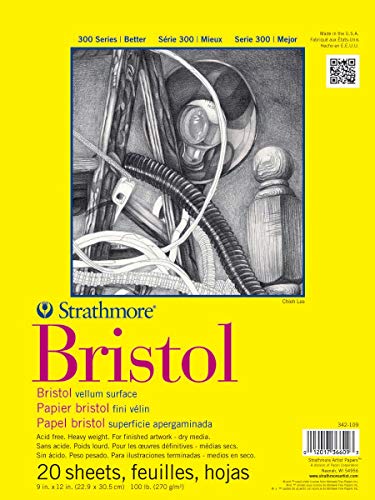
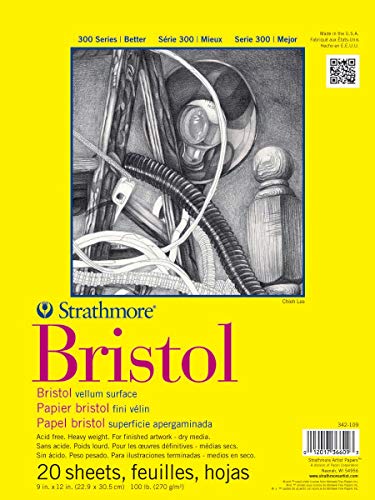
This is the pad I hand to anyone who asks what paper to buy, full stop. It is 100 lb (270 gsm) two-ply Bristol with a vellum surface — genuinely rated “very good” for graphite and colored pencil — in a 20-sheet tape-bound 9×12 pad that usually runs about $10. The tooth grabs pigment for layer after layer without turning your dark fills into a speckled mess, and the stiffness means a heavy burnishing pass will not buckle the sheet. Twenty sheets sounds stingy until you remember each sheet is a finished-piece surface, not scratch paper.
Con: the sheets are a warm cream rather than a bright white, which reads slightly muted under light and bothers colorists who want maximum brightness behind their pigment. The tape-bound edge also means tearing sheets out cleanly takes a little care.
My take: this is the pad that should live on your desk. If you buy one thing from this article, buy this.
Strathmore 300 Series Bristol Smooth — For Detail Work
Check the bundle with both Smooth and Vellum 9×12 pads on Amazon
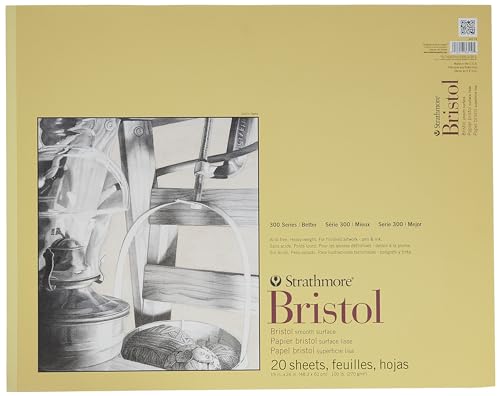
The sibling pad in the same 300 Series line, with almost zero tooth. On smooth Bristol, tiny circular strokes stay crisp, gradients look polished, and there is no texture to fight fine details in mandalas or adult coloring-book line art. The trade is layering headroom: you get roughly two to three good passes before the surface is full, so it rewards a light hand and punishes heavy building. Usually runs about $10–13 for the 9×12 20-sheet pad.
Con: beginners tend to overwork smooth surfaces and burnish too early, which produces a shiny, waxy patch that will not accept more color — the exact frustration this paper gets blamed for when the real issue is stroke order.
My take: buy it as your second pad, for pages where detail and fine line quality matter more than deep layering.
Canson XL Series Mixed Media — The Cheap Volume Play
Check the price of the Canson XL Mixed Media pad on Amazon
When you want lots of sheets to practice on — swatching a new 72-pencil set, testing pressure scales, ruining your first three attempts at a gradient — a Canson XL Mixed Media pad is the budget answer. It is 98 lb (about 260 gsm), has a moderate tooth that takes colored pencil respectably, and a 60-sheet pad typically costs around $12–15. That is roughly 30 cents a sheet versus closer to 50–60 cents on Bristol.
Con: the surface is noticeably more forgiving but less refined — blends do not melt together quite as seamlessly as they do on Bristol vellum, and the sheets are thinner-feeling under repeated erasing.
My take: keep one next to your good pads for practice and swatching. Paying Bristol prices for swatch pages is a waste of good paper.
Arteza Expert 120-Pencil Set — The Budget Palette That Pairs With Any Pad
Check the price of the Arteza 120 pencil tin on Amazon
Not a paper pick, but the pairing matters: paper choice is what makes a budget pencil set look expensive. The Arteza 120-count wax-based set in a tin runs about $50–60 and gives you the wide palette you need to exploit a good multi-layer surface — soft blends, deep shadows, subtle undertones. On cheap thin paper, the extra passes this set rewards would buckle the sheet; on the Strathmore vellum Bristol above, they stack beautifully. It is the same reason the best colored pencils under $20 look twice their price on the right paper.
Con: wax-based cores bloom faster than oil-based ones on burnished fills, and the tins arrive with corners dented often enough that it is practically a tradition.
My take: if your budget splits between one upgrade this month, spend it on paper. Pencils improve color; paper improves everything.
Common Mistakes (And What to Do Instead)
- Testing on the back of printer paper. 20 lb copy paper has essentially no tooth — swatches made on it tell you nothing about how a pencil layers. Keep a dedicated practice pad.
- Choosing “smooth” because smooth sounds better. Smooth surfaces reward confident, minimal-layer technique. If your plan is six layers and a burnished finish, you want vellum tooth.
- Ignoring the tape binding. Tape-bound pads flex at the edge; a sheet that buckles mid-layer accumulates odd pressure artifacts. If a finished piece matters, work on a flat clipboard or remove the sheet first.
- Blaming the pencil for a chalky fill. When dark fills look speckled, it is usually paper with too little tooth to hold more pigment — not a bad pencil. Layer on a toothier sheet and the same pencil looks new.
The Budget Note: What to Buy First
The cheapest setup that still works: one Strathmore 300 Series Bristol Vellum 9×12 pad (about $10) plus whatever pencils you already own. That single pad converts a mid-range set into a finished-art surface and costs less than a fast-food dinner. Add the smooth pad when you start doing detail pieces, and keep a Canson XL pad for practice volume. If you want the deeper background on how weight, binding, and sizing affect your coloring books generally, the coloring book paper quality guide breaks it down further — and if your interest is pulling crisp line detail out of a finished page, the picks in the gel pen guide pair nicely with smooth Bristol.
ColoredCalm is reader-supported. As an Amazon Associate, I earn from qualifying purchases. That means if you buy through one of the links above, I get a small commission at no extra cost to you. I only recommend supplies I actually color with.
🎨 Get Your Free Stress Relief Coloring Guide
Join our newsletter and get this free printable plus weekly tips.
Frequently Asked Questions
What does 'tooth' mean in colored pencil paper?
Tooth is the texture that grabs pigment. Smooth plates suit fine detail and burnishing; medium tooth holds 4-6 layers for depth. No tooth (hot-press) means your pencil skates.
What paper weight is best for colored pencils?
100 lb (170 gsm) or heavier for layered work. Lighter paper buckles when you burnish or use solvent. Pads in the 80-160 lb range cover everything we tested.
How many sheets do I actually need to practice?
One good pad of 15-30 sheets outlasts a beginner month if you test palettes in the margins. Buy tooth variety packs before committing to a full pad of one finish.
Price Check
Prices verified via our product tracker. Updated Sep 27.
| Amazon.com: Strathmore 300 Series Tape Bound Bristol Pad, | $11.14 | 4.8★ (13,326) |
| Amazon.com: Strathmore 300 Series Bristol Smooth Pad, 19"x | $40.13 | 4.7★ (640) |
As an Amazon Associate we earn from qualifying purchases.