This article contains affiliate links. We may earn a commission from qualifying purchases.
Some content on this site is AI-assisted and reviewed by our editorial team.
Coloring Isn’t Just for Relaxation, It’s a Creativity Practice
Most adult coloring advice focuses on stress relief, mindfulness, and relaxation. Those are great reasons to color. But there’s another benefit that gets less attention: coloring is one of the most accessible ways to reconnect with your creative instincts.
Disclosure: As an Amazon Associate, ColoredCalm earns from qualifying purchases. This post contains affiliate links, which means we may earn a commission if you click through and make a purchase, at no additional cost to you.
If you’ve ever stared at a blank sketchbook page and felt paralyzed, you’re not alone. The pressure to create something from nothing is real. Coloring books remove that barrier, the structure is already there. Your job is to make creative decisions: which colors, where to shade, how to blend. And those decisions? They’re the exact same skills that illustrators, designers, and fine artists use every day.
This guide is for people who want to use coloring as a creativity workout, not just a wind-down activity.
How Coloring Activates Your Creative Brain
Coloring sits in a sweet spot between passive consumption and full creative production. Here’s why that matters:
- Low barrier, high reward: You don’t need drawing skills to make something beautiful. This matters because creative confidence is a muscle, and coloring lets you flex it without the risk of “failure.”
- Decision-making practice: Every color choice is a creative decision. Teal or turquoise? Warm or cool palette? Bold contrast or subtle harmony? These micro-decisions train your artistic instinct.
- Pattern recognition: Coloring intricate designs (mandalas, zentangles, Art Nouveau patterns) trains your eye to see structure and repetition, core skills for any visual art.
- Flow state activation: The combination of structured task + creative freedom reliably triggers flow, the state where time disappears and skill meets challenge.
Research from Drexel University found that just 45 minutes of art activity (including coloring) significantly reduces cortisol while increasing creative problem-solving ability. The creativity boost isn’t a side effect, it’s built into the activity itself.
5 Ways to Make Coloring a Creativity Practice
1. Work Within Constraints to Spark Innovation
Counterintuitively, more constraints often lead to more creative results. Try these constraint-based challenges:
- Monochrome challenge: Pick one color family (blues, reds, greens) and complete an entire page using only shades within that family. You’ll learn more about value and saturation in one session than in ten free-choice pages.
- Complementary only: Choose two complementary colors (orange + blue, red + green, purple + yellow) and build the entire page from those two hues plus neutrals.
- Warm/cool split: Make the foreground warm and background cool (or vice versa). This trains color temperature awareness, one of the most powerful tools in any artist’s toolkit.
- The limited palette challenge: Pick exactly 5 pencils or markers and complete a page. When you can’t reach for “the right color,” you learn to mix, layer, and improvise.
2. Study Color Theory Through Coloring
Coloring books are the perfect laboratory for color theory experimentation. Instead of just picking your favorite colors, try applying these principles:
- Analogous schemes: Choose 3-4 colors next to each other on the color wheel (e.g. yellow, yellow-green, green). These always look harmonious and are great for nature-themed pages.
- Triadic schemes: Pick 3 colors evenly spaced on the color wheel (red, yellow, blue or orange, green, purple). These create vibrant, energetic pages.
- Split-complementary: Start with one color, then use the two colors on either side of its complement. More nuanced than straight complementary, still dynamic.
- Value mapping: Before you start coloring, decide where your light source is. Make areas facing the light lighter, areas in shadow darker. This transforms flat coloring into three-dimensional illustration.
Each page becomes a mini color theory lesson. Over time, you’ll develop an intuitive sense for what colors work together, and that instinct transfers to everything from choosing clothes to decorating a room.
3. Treat Each Page Like a Design Project
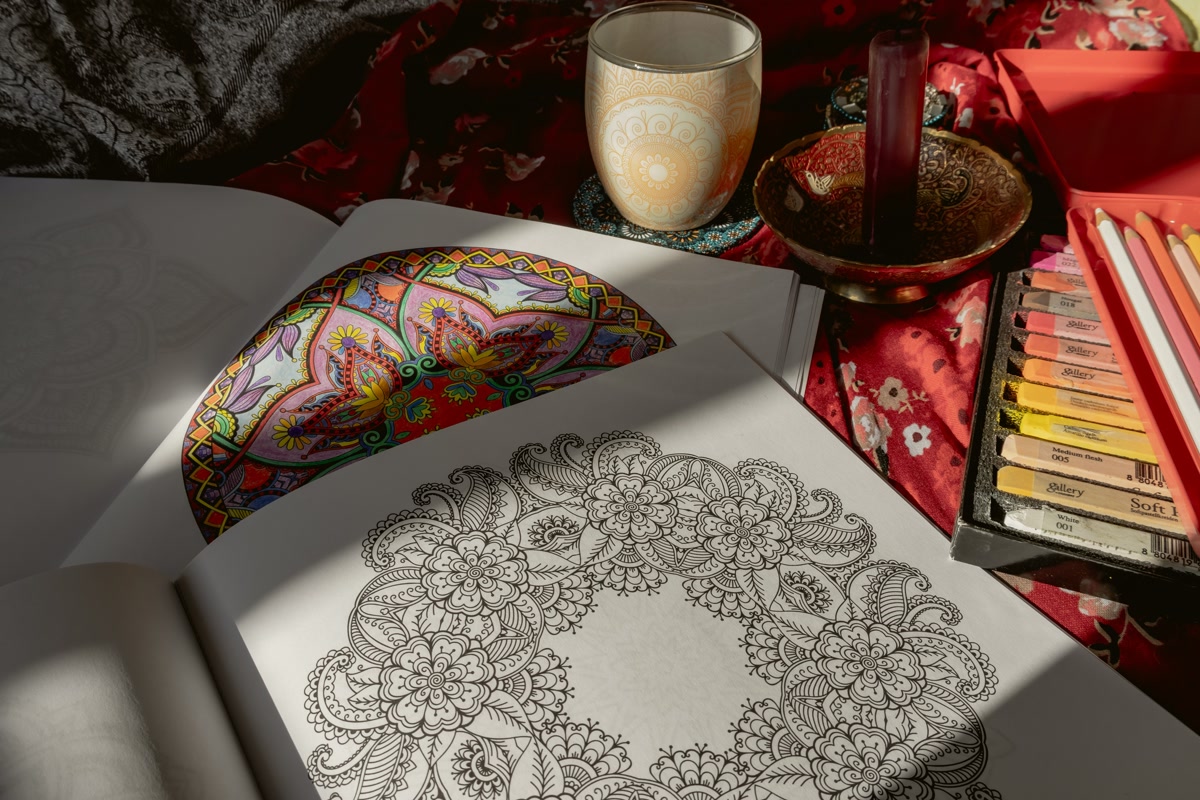
Instead of coloring on autopilot, approach each page with a design brief:
- What’s the mood? Calm ocean morning? Electric city night? Forest at dusk? Decide before you pick up a pencil.
- What’s the focal point? Choose one area to make the star, highest contrast, brightest colors, most detail. Let everything else support it.
- What’s the story? Even abstract patterns can tell a story through color. A mandala colored in sunrise tones tells a different story than the same mandala in midnight blues.
- What would I do differently next time? After finishing a page, spend 30 seconds reflecting. What worked? What would you change? This reflection is where the real learning happens.
4. Develop Your Personal Color Signature
Every artist has a palette that feels like them. Start noticing yours:
- Track your favorites: After a few coloring sessions, look at your completed pages together. You’ll see patterns, maybe you gravitate toward earthy tones, or cool blues, or high-contrast jewel tones.
- Name your palettes: Giving your color combinations names makes them easier to remember and reuse. “Autumn hike,” “rainy Portland,” “tropical sunset”, these become part of your creative vocabulary.
- Push beyond comfort: Once you identify your defaults, deliberately try the opposite. If you always pick cool tones, force yourself to use warm colors for a page. Growth happens at the edge of comfort.

5. Combine Coloring With Other Creative Practices
Coloring becomes even more powerful when you combine it with other creative activities:
- Coloring + journaling: After finishing a page, write about your color choices and what they reveal about your mood. This builds emotional awareness alongside creative skill.
- Coloring + photography: Take a photo that matches your color scheme, then color a page inspired by the photo. Or reverse it: color first, then try to find a scene that matches.
- Coloring + music: Put on a specific song or album and let the music guide your color choices. Fast, rhythmic music tends to produce bold, high-contrast pages. Ambient music leads to soft, flowing palettes.
- Coloring + sketching: After coloring a page, try drawing a simple version of the same design freehand. The structure you internalized while coloring makes the drawing less intimidating.
The Best Supplies for Creative Coloring
If you’re treating coloring as a creativity practice rather than just relaxation, your supplies matter more. Here’s what supports creative exploration:
For Color Range: Prismacolor Premier 72-Color Set
Creativity thrives on options. The Prismacolor Premier 72-color set gives you enough shades to experiment with color theory, build smooth gradients, and match any mood. The soft, wax-based cores are made for blending, the cornerstone technique of creative coloring.
Prismacolor Premier 72-Color Colored Pencils on Amazon →
For Bold Experimentation: Ohuhu Honolulu 80-Color Markers
Alcohol markers force different creative decisions than pencils. They blend like paint, dry fast, and produce vibrant, saturated results. The Ohuhu Honolulu 80-color set is affordable enough to experiment freely without worrying about “wasting” expensive markers.
Ohuhu Honolulu 80-Color Markers on Amazon →
For Structure and Focus: Kum Automatic Long Point Sharpener
Creativity requires tools that work with you, not against you. A bad sharpener crushes pencil leads and breaks your flow. The Kum Automatic Long Point produces a long, tapered point that’s perfect for both fine detail and broad strokes, no switching tools mid-creative-flow.
Kum Automatic Long Point Sharpener on Amazon →
For Creative Patterns: Secret Garden by Johanna Basford
If you want to push your creative boundaries, you need coloring books with enough detail to challenge you. Secret Garden remains the gold standard, intricate botanical designs that reward bold color choices and careful shading.
Secret Garden by Johanna Basford on Amazon →
For Mood-Based Coloring: World of Flowers by Johanna Basford
Basford’s floral designs are perfect for the color-mood exercises in this guide. Each page has enough variety to support any palette, warm, cool, monochrome, or wild.
World of Flowers by Johanna Basford on Amazon →
A 7-Day Creativity Challenge
Want to put this into practice? Try this week-long challenge:
- Day 1, Monochrome: Pick one hue and complete a page using only that color family. Notice how value (light-to-dark) creates depth without multiple hues.
- Day 2, Complementary clash: Choose two complementary colors. Push yourself to make them work together through careful value balance.
- Day 3, Mood board coloring: Choose a mood (calm, energetic, nostalgic, mysterious) and select colors that express it before you start coloring.
- Day 4, Music-driven coloring: Put on one album and color the entire page in one sitting, letting the music guide every color choice.
- Day 5, Limited palette: Pick exactly 5 pencils. Complete a page using only those 5 colors, mixing and layering to create the illusion of more.
- Day 6, Photography-inspired: Take a photo of something near you. Color a page using the same color palette as your photo.
- Day 7, Break the rules: Color outside the lines. Use unexpected colors. Try a technique you’ve never tried. Make it weird on purpose.
By day 7, you’ll have a visual record of your creative growth, and a much stronger instinct for color, composition, and expression.
Coloring as a Gateway to Other Art Forms
One of the most underappreciated things about adult coloring is that it’s a gateway drug to other creative practices. The skills you build, color selection, shading, composition, patience, transfer directly to:
- Watercolor painting: The blending and layering instincts you develop with pencils and markers make watercolor feel less intimidating
- Digital illustration: Color theory and composition skills are identical whether the medium is pencil or pixel
- Fashion and interior design: Understanding color palettes and mood translates directly to styling spaces and outfits
- Photography: Recognizing good color combinations makes you a better editor and a more intentional photographer
You don’t have to “graduate” from coloring to these other forms. Coloring is a valid creative practice on its own. But if you ever want to explore further, you’ll have a head start.
The Creative Benefit Nobody Talks About
Here’s the thing about creativity that most advice misses: it’s not about talent. It’s about volume. The people who seem effortlessly creative are usually just the ones who’ve made more things, more sketches, more color choices, more experiments, more “failures.”
Coloring gives you a low-stakes way to increase your creative volume. Every page you color is another data point, another experiment, another small win that builds your creative confidence. And that confidence, the belief that you can make something beautiful, is the real prize.
So pick up your pencils. Choose wild colors. Make “mistakes.” The only wrong way to color is not to start.
Not a Prime member yet? Get FREE 2-day shipping on millions of items, plus access to Prime Video, Prime Music, and Prime Reading. Start your 30-day Prime free trial
Bottom Line
Coloring is a legitimate creative practice, not just a stress-relief tool. Use it to explore color theory, develop technique, and express yourself without pressure. The more you color, the more your personal style will emerge.
🎨 Get Your Free Stress Relief Coloring Guide
Join our newsletter and get this free printable plus weekly tips.
Price Check
Prices verified via our product tracker. Updated Sep 27.
| Amazon.com : Prismacolor Premier Colored Pencils, Soft Cor | $74.99 | 4.8★ (29,632) |
| Amazon.com : Ohuhu Alcohol Markers 80 Colors for Beginners | $39.99 | 4.6★ (1,381) |
| Amazon.com: Kum AS2, Two Hole Automatic Long Point Pencil | $8.10 | 4.5★ (1,942) |
| Secret Garden: An Inky Treasure Hunt and Coloring Book for | $15.95 | 4.7★ (16,080) |
| Amazon.com: World of Flowers: A Coloring Book and Floral A | $16.95 | 4.8★ (6,166) |
As an Amazon Associate we earn from qualifying purchases.