This article contains affiliate links. We may earn a commission from qualifying purchases.
Some content on this site is AI-assisted and reviewed by our editorial team.
You know the feeling. You’re twenty minutes into a page, the linework is finally behaving, and your fineliner starts skipping mid-spiral — so you scribble circles on scrap paper until it limps back. Or the ink feathers out along the paper fibers like a tiny root system. Or the tip goes soft and fuzzy after a few nights, and the crisp 0.25 mm line you started with quietly doubles in width.
None of that is bad luck, and it’s rarely a bad pen. It’s a mismatch — the wrong tip for the paper, the wrong pressure for the tip, or cheap dye ink asked to do archival work. We compare colored pencils for weeks and buy pens on autopilot, so let’s do this properly: the pigment-ink standards — Sakura’s Pigma Micron and Staedtler’s Pigment Liner — against a genuinely good budget set, tested on real coloring-book pages.
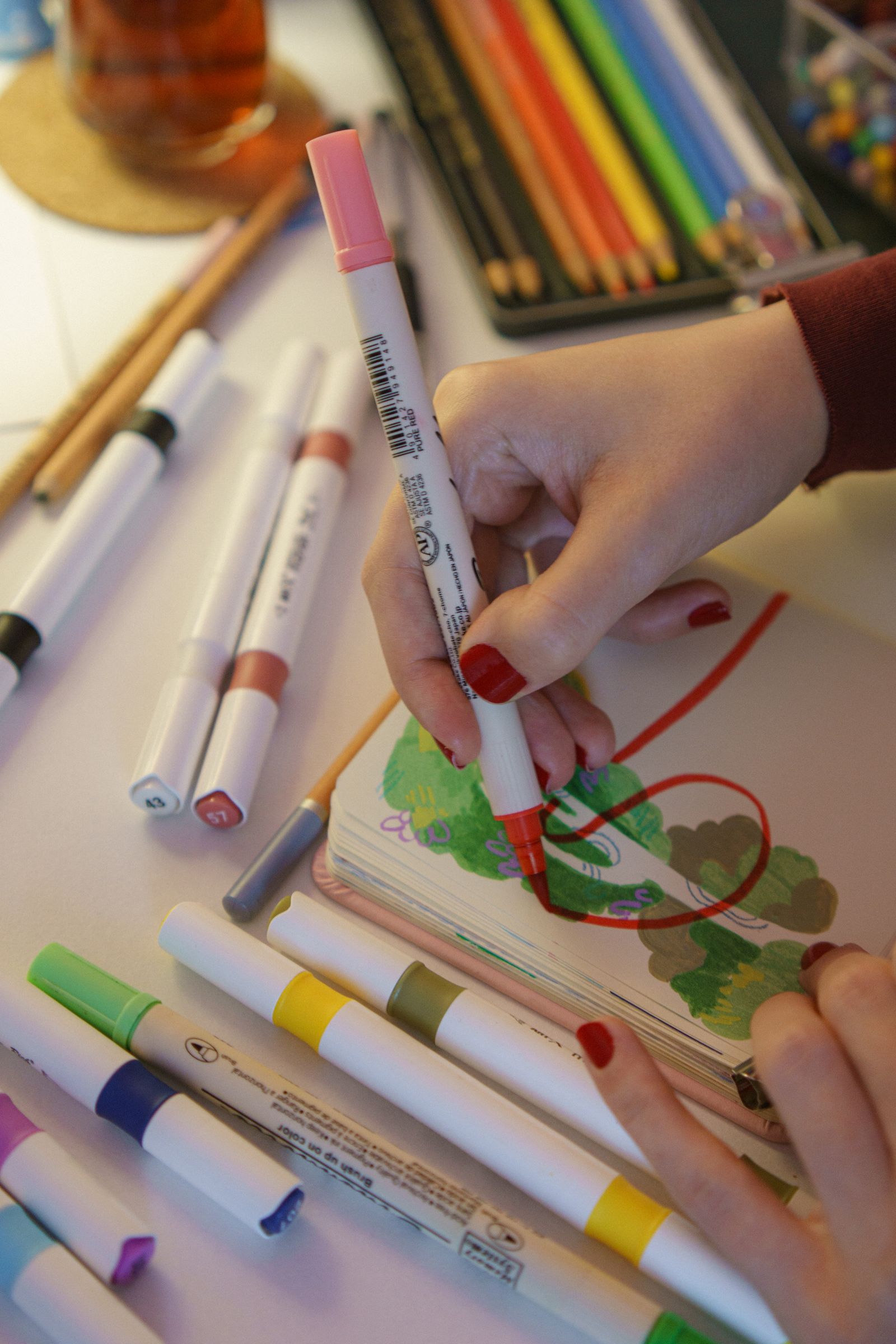
I ran each set through the ink test that matters: long evening sessions, a mix of smooth and toothy pages, and the too-firm grip we all slip into when we’re tired. Here’s what survived, and what I’d skip.
Sakura Pigma Micron 6-Pack — The Archival Standard
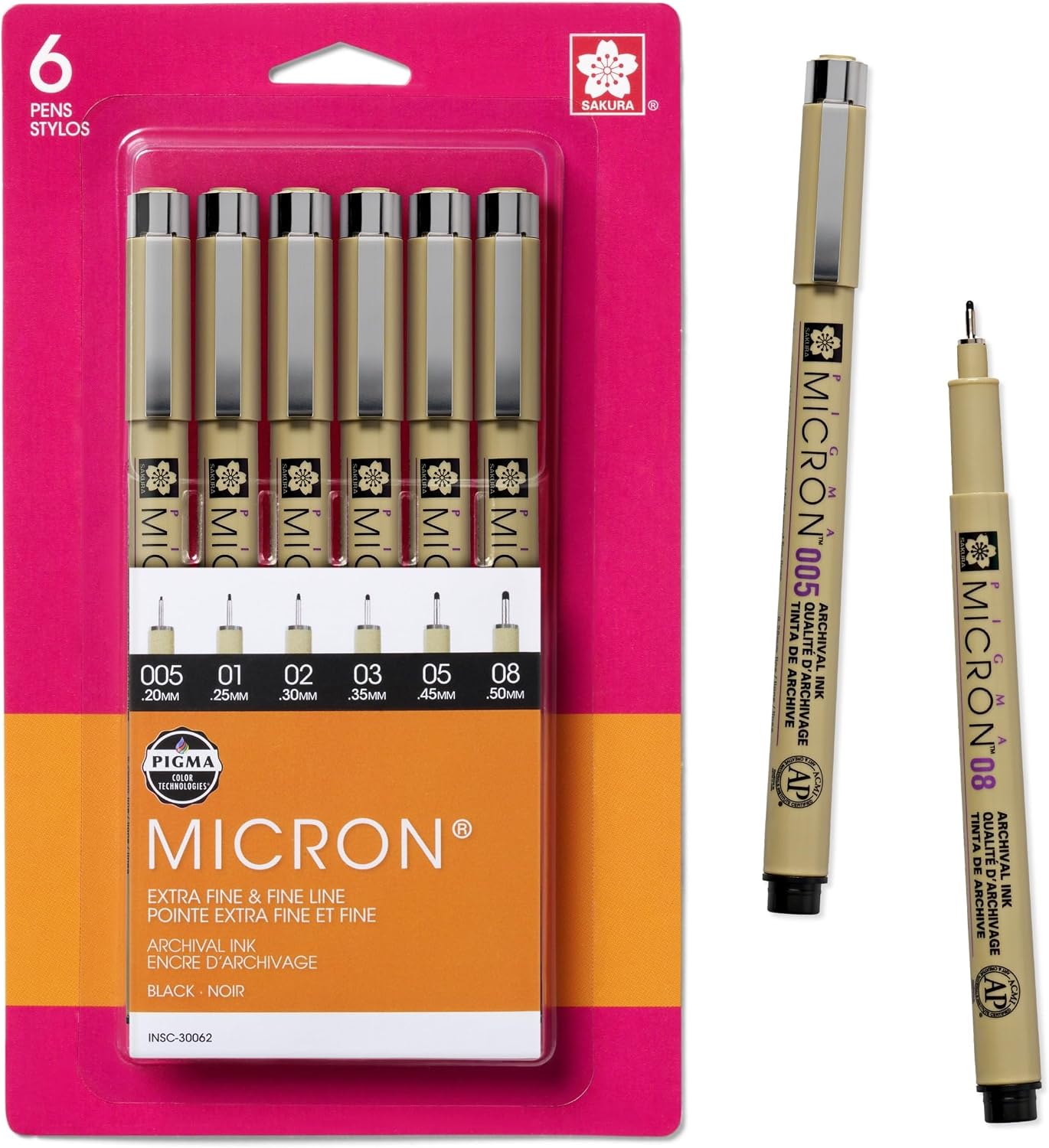
The Sakura Pigma Micron 6-Pack Assorted (01-08) is the pen that made “archival” mean something in coloring. Pigma ink is pigment-based — actual pigment particles that bind into the paper fibers — so the lines are waterproof, smear-proof, and stay black for decades instead of ghosting to grey. That’s why illustrators reach for a Micron before laying watercolor or alcohol markers over a drawing: the linework holds. More than 62,000 reviews on Amazon isn’t marketing noise; it’s decades of the ink doing what the box promises.
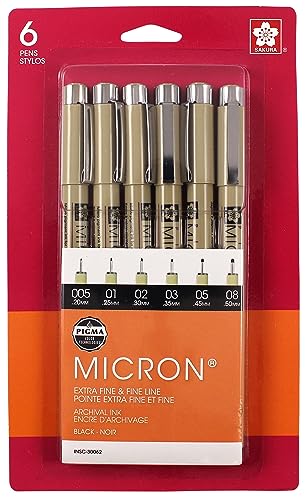
The assorted six-pack covers the coloring range well: an 01 for tight patterns and hairlines, an 02 and 03 for everyday linework, a 05 for bolder shapes, an 08 for borders and framing, and a brush tip for solid fills. Line widths are honest — an 01 draws a true 0.25 mm line and holds it.
The honest con: the tips are bonded fiber, not steel, and they mushroom if you press hard — which toothy paper makes almost irresistible. Once a tip flares, the line fattens for good. And at about $11 for the set, they’re the priciest pens here, drop for drop.
My take: the standard for a reason. If you color on smooth or medium-weight paper and want lines that are still black in ten years, buy this set first. Press like you’re tickling the page and each pen lasts months.
STAEDTLER Pigment Liner 12-Set — The Full Width Ladder
The STAEDTLER Pigment Liner 12-Set (0.05-1.2 mm) is what you buy when you want to feel the difference between line weights instead of guessing at it. Twelve nibs, from a 0.05 hairline up to a 1.2 mm border pen, all running archival, waterproof pigment ink like the Micron — a full ladder for dense coloring-book pages.
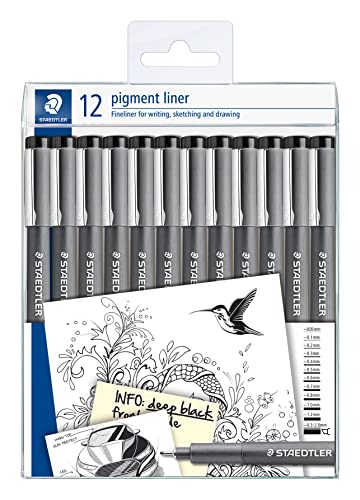
Two things Staedtler does better than anyone. The Dry Safe cap-off guarantee means an uncapped pen survives hours, not seconds. And the tips are metal-clad — a fine steel collar that keeps line width stable and refuses to fray the way bare fiber does.
The honest cons: on soft or coated pages, that metal-clad tip skates instead of gripping, and the line wanders where it wants. And twelve widths is illustrator territory — a colorist will lean on four or five, so you’re paying for rungs you rarely climb.
My take: the best second set. Buy your daily Micron trio first; add this ladder when you want deliberate line-weight contrast — especially if you’re the kind of person who leaves a pen uncapped between sessions.
Ohuhu Fine Line Pens (7-Pack) — The Under-$10 Starter
Every hobby deserves a low-stakes entry point, and the Ohuhu Fine Line Pens, Black (7-Pack) is it for fineliners. For about the price of two Pigma Microns you get seven nibs spanning hairline to border, water-based ink that dries fast without feathering on standard book paper, and nothing too precious to toss in a travel bag.
The honest cons: side by side with a Micron, the Ohuhu black dries a slightly cooler grey-black rather than dense carbon. Ohuhu doesn’t publish lightfastness specs the way Sakura does, so I wouldn’t trust them with art headed for a sunny wall. And budget nibs vary a little more — test each pen on scrap before committing it to a finished page.
My take: the best first set, full stop. Hand it to a newer colorist without hesitation; if pens become their thing, the Microns will still be there.
Worlds of Wonder: A Coloring Book for the Curious — The Intricate-Lines Companion
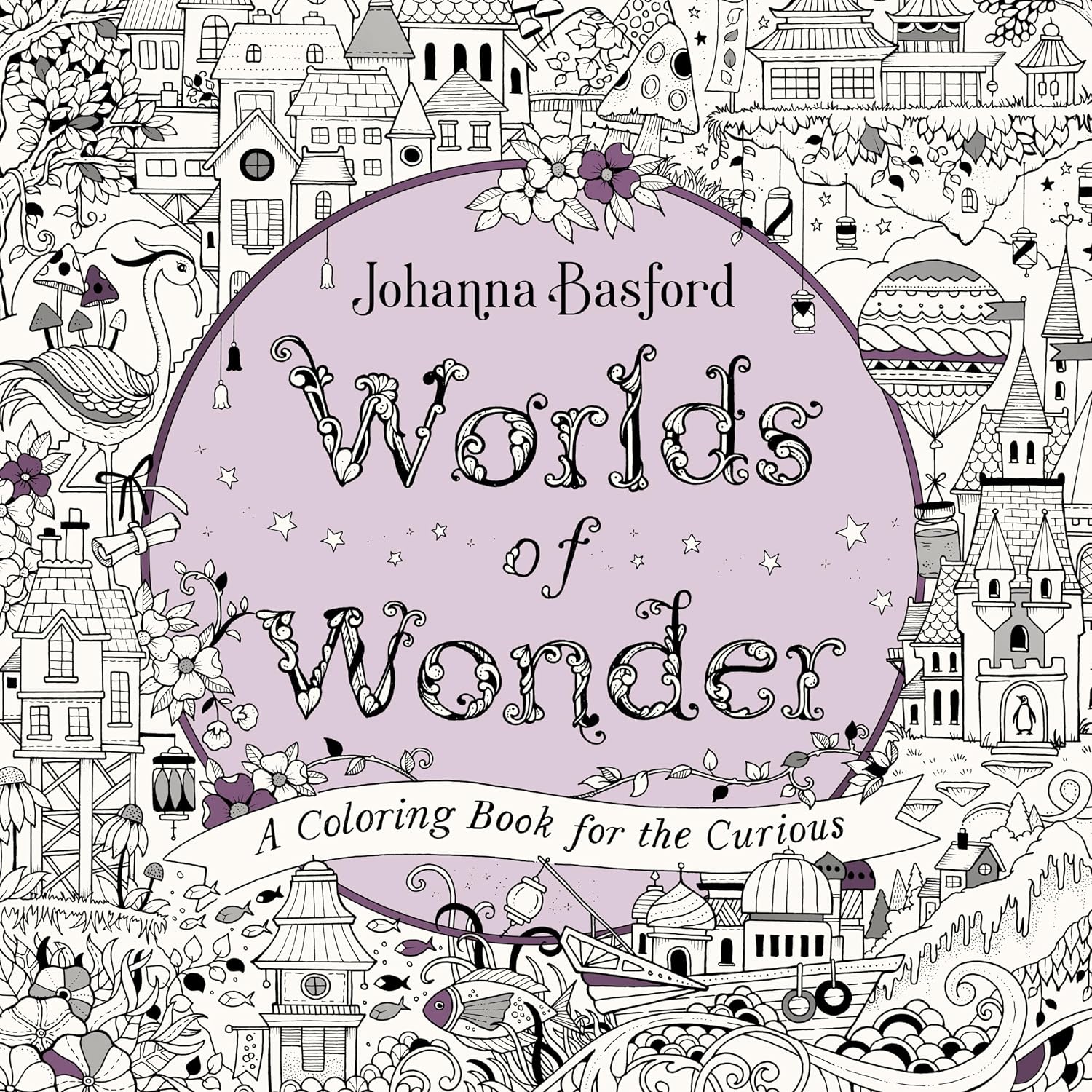
Pens earn their keep on pages that demand them, and Worlds of Wonder: A Coloring Book for the Curious demands. It’s dense, curious scenes — tiny architecture, tangled flora, patterns packed edge to edge — with linework that genuinely justifies owning three widths at once: a 01 for micro-detail, a 03 for mid-weight texture, an 08 for frames. Color a page like that with one medium pen and it flattens; work three widths and it suddenly has hierarchy.
The honest cons: the pages run thinner than a dedicated marker book’s, so keep a blotter sheet behind the page if you layer wet media over the lines — pigment fineliners barely ghost, but markers will show through. And the density is slow food; it rewards an unhurried evening, not a one-sitting sprint.
My take: the book that makes a width ladder feel like a palette. Pair it with any of the pen sets above — pens plus a dense book is where supplies turn into technique.
Four Pen Mistakes That Ruin Good Linework
Pressing like it’s a ballpoint. Fineliner tips are fiber, built to glide, not to be pushed. Ballpoint pressure on toothy paper mushrooms a tip within a page or two, and the damage is permanent. Let the ink do the work.
Using one width for everything. A 05 in a one-millimeter space floods the detail; an 01 on a full-page border takes all evening. Match the tip to the smallest space it has to fit, and size up for outlines and frames.
Pairing pigment pens with the wrong paper. Pencil people chase tooth because it grips pigment — my coloring book paper quality guide covers that side — but fineliners are the opposite: tooth is what frays a fiber tip, and soft coated pages make metal-clad tips skate. Smooth-to-medium paper is a fineliner’s home turf.
Leaving pens uncapped “for a second.” A second becomes a phone call becomes a dead nib. Dry Safe windows are a safety net, not a license — make the cap click part of your rhythm and the pen outlives the project.
The Cheapest Setup That Still Works
You don’t need the archival tier to enjoy any of this. The Ohuhu 7-pack plus any small Strathmore pad is a genuinely good kit for the price of takeout — the pens land under $10 — and it teaches you which tip sizes you actually reach for before you invest in pigment ink. If your book stack needs company, my roundup of the best adult coloring books for stress relief is full of pages that deserve fine linework.
Deep-focus coloring hits different with an audiobook — Audible’s free trial is here.
ColoredCalm is reader-supported. As an Amazon Associate, I earn from qualifying purchases. That means if you buy through one of the links above, I get a small commission at no extra cost to you. I only recommend supplies I actually color with.
🎨 Get Your Free Stress Relief Coloring Guide
Join our newsletter and get this free printable plus weekly tips.
Frequently Asked Questions
What are the best fineliner pens for coloring books?
The Sakura Pigma Micron is the gold standard — archival pigment ink that won't fade, in tip sizes from 003 (hairline) to 08 (bold outlines). For a budget alternative, the Ohuhu 7-pack covers the same range for under $10, though the ink dries slightly less black than Pigma.
Which pen sizes do I need for tiny details?
For most coloring-book detail work, you need two sizes: an 01 (0.25 mm) for tight patterns and tiny outlines, and an 03 or 05 (0.30–0.45 mm) for general linework. Anything finer than 01 is for stippling and micro-detail; anything thicker than 08 is for borders and framing.
Do Pigma Microns dry out fast?
They dry out faster than ballpoints if you leave them uncapped, but Sakura's cap-off guarantee covers up to 48 hours. The real killer is pressing too hard on toothy paper — the felt tip mushrooms and frays, which feels like 'drying out' but is actually mechanical damage. Light pressure and a cap click after every use will keep a Micron going for months.
Liked this guide? Get the next one in your inbox — the coloring starter checklist is free too.
✓ You're in — check your inbox.
No spam. Unsubscribe anytime. We never share your email.
Price Check
Prices verified via our product tracker. Updated Oct 31.
| Sakura Pigma Micron Fineliner Pens, Black, Assorted Points | $12.63 | 4.8★ (65,449) |
| Worlds of Wonder: A Coloring Book for the Curious: 9780143 | $17.95 | 4.8★ (6,100) |
As an Amazon Associate we earn from qualifying purchases.