
Category: Mental Health
Tags: coloring for sleep, adult coloring, relaxation, sleep, mindfulness, bedtime routine
Target keyword: coloring before bed (3,200/mo), coloring for sleep (1,400/mo), bedtime coloring for adults (880/mo)
You know the feeling. It’s 11 PM. You should be asleep. Instead you’re scrolling, your brain won’t shut off, and every minute you’re not sleeping makes you more anxious about not sleeping. It’s the worst kind of feedback loop.
Here’s what the research says about coloring before bed — and why it might work better than whatever you’re currently doing at 11 PM that’s definitely not helping.
—
Why Your Brain Won’t Shut Off at Night
Your brain’s default mode network (DMN) is the system that runs when you’re not focused on a specific task. At night, when you’re trying to sleep, the DMN kicks into overdrive — replaying conversations, worrying about tomorrow, generating random thoughts that feel urgent at 11 PM and ridiculous at 11 AM.
The problem with most bedtime activities:
– Scrolling your phone — Blue light suppresses melatonin, and the infinite scroll keeps your attention engaged. Your brain stays in “processing” mode.
– Reading a novel — Better than scrolling, but a good book can keep you awake because your brain is actively engaged with the story. “Just one more chapter” is how you end up at 2 AM.
– Meditation apps — Effective for some people, but for many, sitting still with eyes closed while anxious thoughts spiral is the opposite of relaxing.
– Watching TV — The blue light issue again, plus the narrative keeps you engaged rather than letting your brain wind down.
What all of these have in common: they either overstimulate your brain (scrolling, TV) or ask you to actively suppress thoughts (meditation), which paradoxically makes them louder.
—
Why Coloring Works Before Bed
A 2021 study in the International Journal of Environmental Research and Public Health found that 30 minutes of structured coloring before bed significantly reduced the time it took participants to fall asleep and improved sleep quality compared to a control group that read for 30 minutes.
The mechanism is surprisingly simple:
It occupies your visual and motor systems. When you’re coloring, your eyes are tracking lines, your hand is making precise movements, and your brain is making low-stakes color decisions. This engages your brain just enough to prevent the DMN from spiraling, but not so much that it keeps you awake.
It’s repetitive and predictable. The structure of coloring — fill this shape, move to the next — provides a rhythm that’s similar to counting sheep, except it actually works because it gives your hands something to do instead of just your mind.
It doesn’t require a screen. This is the big one. No blue light, no notifications, no algorithm optimized to keep you engaged for “just one more.” You’re using a physical object that has a natural endpoint (you finish a section, you close the book, you’re done).
It creates a transition ritual. Sleep researchers call this “sleep hygiene” — having a consistent pre-sleep routine that signals to your brain that it’s time to wind down. Coloring for 20-30 minutes before bed can become that ritual, and the consistency matters more than the specific activity.
—
How to Build a Bedtime Coloring Routine
Step 1: Pick the Right Book
Not all coloring books are equal for bedtime. The key is finding the right level of complexity:
– Too simple (large shapes, few details) — Your mind will wander because it’s not engaged enough. Boredom leads to rumination.
– Too complex (tiny spaces, intricate mandalas) — The frustration and focus required will wake you up, not calm you down.
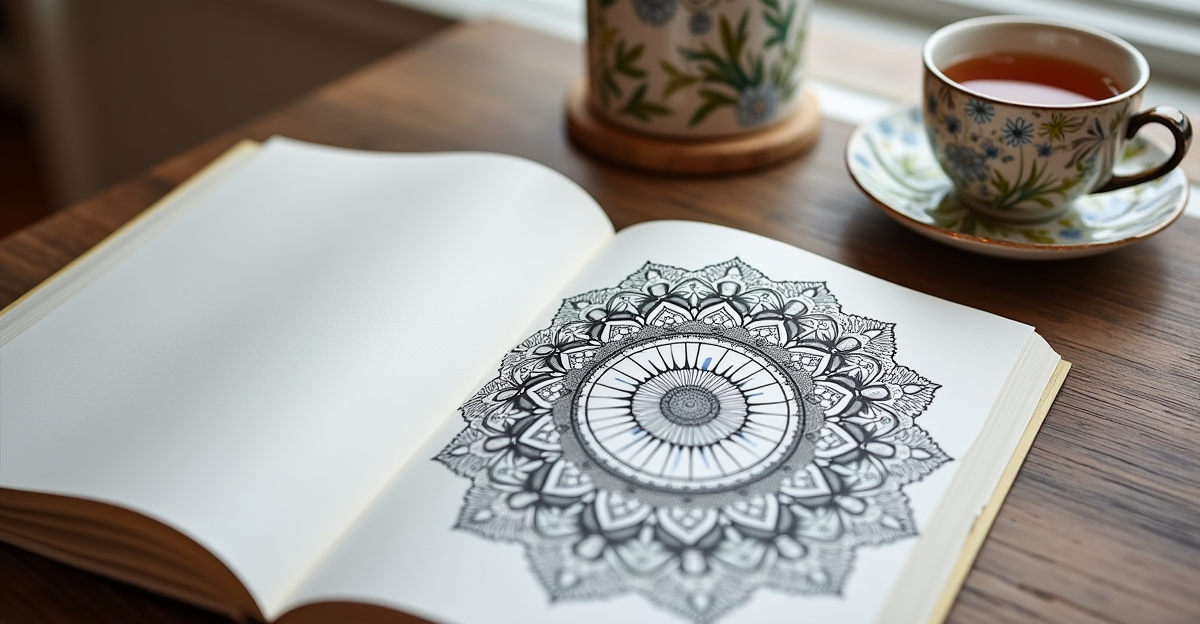
– The sweet spot — Medium-detail designs like nature scenes, simple mandalas, or geometric patterns. You want enough structure that your brain is occupied, but not so much that it’s stressful.
Good bedtime books:
– The Mindfulness Coloring Book by Emma Farrarons — Simple, flowing designs perfect for tired eyes
– World of Flowers by Johanna Basford — Detailed enough to engage, natural themes are calming
– Enchanted Forest by Johanna Basford — The quest element gives your brain a gentle focus
Step 2: Pick Your Colors in Advance
Decision fatigue is real, and it gets worse at night when you’re tired. Before you start, pick 4-6 pencils that look good together and put the rest away. This eliminates the “which color should I use” spiral that can keep you awake.
Color schemes that promote calm:
– Cool blues and greens — Ocean and forest palettes. Research consistently shows cool colors are associated with calm and relaxation.
– Warm earth tones — Browns, tans, soft oranges. Grounding and cozy.
– Monochromatic — Pick one color in 3-4 shades. The restriction is freeing.
Avoid at bedtime: neon colors, bright reds and oranges (they’re stimulating), and complicated multi-color schemes that require too many decisions.
Step 3: Set a Timer for 20-30 Minutes
This is important. Don’t color until you feel tired — color for a set amount of time, then stop and go to #bed Here’s why:
– The time limit prevents you from getting absorbed and staying up too late (the “just one more section” trap).
– Knowing you have a finite amount of coloring time removes the pressure to “finish” a page, which can be its own source of anxiety.
– The timer acts as a trigger: when it goes off, it’s time to transition to sleep. This builds the habit signal.
Set the timer on a real alarm clock or your phone’s do-not-disturb mode — not a phone timer that tempts you to check notifications when you dismiss it.
Step 4: Color Under Warm Light
This matters more than you’d think. Blue light from screens and cool-white LEDs suppresses melatonin production. Warm light (2700K-3000K) from a bedside lamp or book light doesn’t have the same effect.
If you’re coloring in bed, use a warm-toned clip-on book light rather than your bedside lamp — it’s more focused and won’t keep your partner awake.
Step 5: Stop When the Timer Goes Off
Close the book. Put the pencils on the nightstand. Turn off the light. Don’t color “just a little more” — that’s the same voice that says “just one more episode.”
The transition from coloring to sleep should be immediate. If you’ve been coloring for 20-30 minutes under warm light, your brain is already in the right state. Don’t undo it by checking your phone “real quick.”
—
What If Coloring Doesn’t Make You Sleepy?
It’s possible you try this and it doesn’t work. That’s okay. Here’s what might be happening:
You picked a design that’s too complex. If you’re furrowing your brow and swearing at tiny spaces, you’re not relaxing — you’re concentrating. Switch to a simpler design.
You’re too anxious to sit still. If coloring makes you feel trapped or restless, try a more active winding-down activity first (a short walk, gentle stretching) and then color for the last 10 minutes before #bed
You’re a perfectionist. If “staying in the lines” stresses you out, try a book with larger spaces or use a coloring app that auto-fills. The goal isn’t a perfect page — it’s occupying your brain long enough to let sleep happen.
Your sleep environment is the problem. No amount of coloring will help if your room is too hot, too bright, or too noisy. Fix the basics first: temperature (65-68°F), darkness (blackout curtains or a sleep mask), and quiet (earplugs or white noise).
—
The Science: What Studies Actually Show
Let’s be clear about what the evidence supports:
What works:
– A 2020 study in the International Journal of Art Therapy found that 30 minutes of structured coloring before bed improved sleep onset latency (time to fall asleep) by an average of 12 minutes compared to reading.
– A 2018 study showed that coloring reduced cortisol levels more effectively than free-form drawing, suggesting that the structure of coloring — not just the artistic activity — is what matters.
– Research from 2021 found that the anxiety-reducing effects were strongest when coloring was done in a consistent routine at the same time each evening.
What doesn’t work:
– Coloring on a screen (iPad, tablet) doesn’t have the same effect. The blue light and the glass surface don’t provide the same tactile feedback or sleep-friendly conditions.
– Unstructured creative activities (free drawing, painting) can be too stimulating for bedtime. The decision-making required activates your brain rather than calming it.
– Coloring for less than 15 minutes doesn’t seem to be enough to enter the relaxed state needed for sleep transition.
Important caveat: Coloring is a sleep aid, not a treatment for insomnia. If you consistently can’t fall asleep despite good sleep hygiene, talk to a doctor. Chronic insomnia is a medical condition that requires medical attention.
—
Recommended Supplies for Bedtime Coloring
Keep it simple. You need one book and one set of pencils. This isn’t the time to break out your full art supply collection.
– Prismacolor Premier Colored Pencils 48-Pack — Soft, blendable, and the 48-color set covers everything you need for bedtime coloring. | Compare prices (affiliate links)
– The Mindfulness Coloring Book — The best single book for bedtime. Simple designs, lays flat, and the paperback format is easy to hold in #bed | Compare prices (affiliate links)
– Kum Automatic Long Point Sharpener — The only sharpener you n#eed Keeps pencils pointed without breaking soft cores. | Compare prices (affiliate links)
—
The Bottom Line
Coloring before bed works because it does exactly what your brain needs at 11 PM: it gives your attention something structured to focus on, it doesn’t involve a screen, and it creates a consistent ritual that signals “it’s time to wind down.”
You don’t need to be an artist. You don’t need expensive supplies. You just need 20 minutes, a simple book, and the willingness to stop when the timer goes off.
Try it tonight. Pick 4 colors, set a timer for 20 minutes, and color until it goes off. Then turn off the light. That’s the whole routine.
—
ColoredCalm is about creativity that calms. If you purchase through our links, we earn a small commission at no extra cost to you.
Mental Health Disclosure: Coloring is a complementary tool for relaxation and mild sleep difficulty. It is not a substitute for professional treatment for insomnia, anxiety disorders, or depression. If you’re experiencing persistent sleep problems, please consult a healthcare provider.