
This article contains affiliate links. We may earn a commission from qualifying purchases.
Some content on this site is AI-assisted and reviewed by our editorial team.
Target keyword: coloring for stress relief at work (1,900/mo), desk friendly coloring (720/mo), adult coloring break (880/mo)
Meta description: Can coloring at your desk actually reduce work stress? Yes, and here’s the science, supplies, and 10-minute routines that make it work in any office.
Category: Mental Health
Tags: stress relief, adult coloring, workplace wellness, desk friendly, mindfulness
Affiliate tag: strongdogsmar-20 (Amazon)
You Don’t Need a Meditation Room. You Need a Coloring Break.
It’s 2:47 PM. Your inbox is overflowing, Slack won’t stop buzzing, and your brain feels like wet sand. That’s not just “being busy.” That’s your nervous system running on cortisol and caffeine.
Most stress advice says “take a walk” or “meditate.” Great, except you’re in an open office with back-to-back meetings. You can’t exactly roll out a yoga mat at your desk.
But you can open a coloring book. And that 10 minutes might do more for your focus than another cup of coffee ever could.
The Science: Why Coloring Works When You’re Stressed
Here’s what happens in your brain when you sit down with a coloring page:
1. Your cortisol drops. A 2020 study in the International Journal of Environmental Research and Public Health found that just 20 minutes of structured coloring significantly reduced cortisol levels compared to free-drawing or reading.
2. Your parasympathetic system kicks in. The repetitive, predictable motion of filling in shapes activates your “rest and digest” response. Heart rate slows. Breathing deepens. Your body physically calms down.
3. You enter a flow state. Coloring gives your brain just enough challenge (which color goes where? how do I shade this?) to stay engaged, but not so much that it triggers anxiety. That sweet spot, called “low-stakes flow,” is where stress relief happens.
4. It’s active, not passive. Unlike scrolling your phone (which increases stress hormones), coloring requires gentle focus. Your brain can’t simultaneously spiral about that awkward email and pick the right shade of teal.
Desk-Friendly Supplies That Won’t Get You Side-Eyed
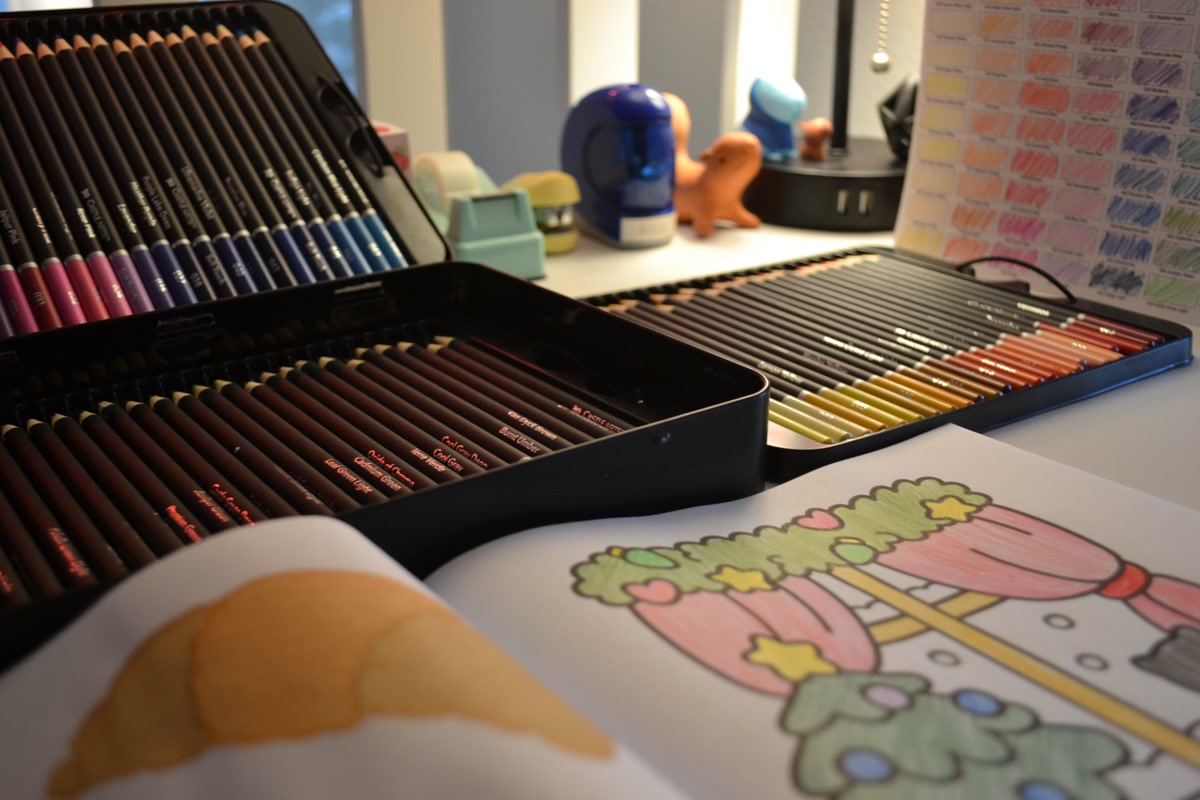
You need supplies that are quiet, compact, and don’t scream “I’m having a moment” to your coworkers. Here’s what works:
Pencils (Quiet and Professional)
- Prismacolor Premier 24-Color Set: Soft cores, vibrant colors, small enough for a desk drawer (~$15)
- Faber-Castell Polychromos 24-Color Set: Oil-based, won’t break in your bag, buttery smooth (~$28)
- Crayola Colored Pencils 50-Count: Budget pick that gets the job done (~$8)
Markers (If You Have a Private Office)
- Tombow Dual Brush Pens: Flexible brush tip plus fine tip, water-based, no bleed (~$18)
- Crayola Super Tips 50-Count: Cheap, washable, surprisingly nice for coloring (~$8)
Books (Flat, Discreet, No Judgment)
- Mindfulness Coloring Book (Farrarons): Pocket-sized, elegant designs, perfect for desk breaks (~$9)
- World of Flowers (Basford): Beautiful, detailed, great for longer sessions (~$10)
- Tropical World (Marotta): Intricate animals and plants, very absorbing (~$9)
Desk storage tip: Keep your supplies in a zip pouch in your desk drawer. Pull it out, color for 10 minutes, zip it back. No mess, no drama.
3 Workday Coloring Routines (Choose Your Break)
The 5-Minute Reset
When: Between meetings, before a big presentation, after a tough call.
- Open your coloring book to a page you’ve already started
- Pick up where you left off, don’t start a new section
- Set a 5-minute timer
- Color with light pressure, focusing on the feel of the pencil on paper
- When the timer goes off, close the book and go
Why it works: Continuing an existing page removes decision fatigue. The time limit keeps you from overthinking. Five minutes is enough to activate your parasympathetic system.
The Lunch Break Decompress
When: Your actual lunch break (you are taking one, right?)
- Grab your coloring kit and find a quiet spot: break room, park bench, your car
- Start a new section or a new page
- Color for 15 to 20 minutes
- Eat your lunch (yes, separately, mindful coloring deserves your full attention)
Why it works: A 20-minute coloring session can reduce cortisol by up to 25%. Doing this during lunch means you return to your afternoon refreshed instead of depleted.
The End-of-Day Wind Down
When: Last 15 minutes of your workday, before shutting your laptop.
- Pick a section that needs finishing
- Color slowly and deliberately. This is not about speed.
- Use this time to mentally transition from “work mode” to “life mode”
- When the page section is done, close the book. You’re done for the day.
Why it works: This creates a ritual that signals your brain: work is over. It’s the same principle as a commute. You need a transition. Coloring is that transition.
How to Handle the “Is That a Coloring Book?” Coworkers
Let’s be real. Some people will judge. Here’s how to deal:
- “It’s adult coloring. It’s a mindfulness practice.” (Accurate and shuts down follow-ups.)
- “Research shows it reduces cortisol more effectively than meditation for beginners.” (True, and sounds official.)
- “It’s cheaper than therapy.” (Gets a laugh, ends the conversation.)
- “Want to try?” (The boldest move. You’d be surprised how many people say yes.)
Honesty: most people either don’t care or are secretly jealous. The ones who make comments are usually the ones who need it most.
What Coloring at Work Actually Feels Like
You’re not going to have a mystical experience at your desk. What you will feel:
- Your shoulders drop, literally, within about 3 minutes
- Your breathing slows, you’ll notice you’re no longer holding your breath
- Your thoughts stop racing, the spiral gets interrupted
- You feel capable again, not zen, just functional
That’s the goal. Not enlightenment. Just enough calm to send that email without regretting it.

The Bigger Picture: Stress Isn’t Going Away
Your job is stressful. Your commute is stressful. The news is stressful. Coloring won’t fix any of those things. But it gives you a tool, a real, evidence-based tool, to manage your stress response in the moment.
Think of it like stretching. You don’t stretch because your muscles are broken. You stretch because you sit all day and your body needs it. Coloring is the same thing, but for your brain.
And unlike meditation apps, breathing exercises, or therapy apps that require subscriptions and tutorials, coloring works immediately. Open book. Pick pencil. Go.
Ready to Start?
- Need a book? Our best coloring books for beginners guide has picks for every style.
- Need pencils? Our best colored pencils for adult coloring guide covers every budget.
- Want the science? Our guide to how coloring reduces stress dives deeper into the research.
ColoredCalm: Because your lunch break deserves better than doomscrolling.
Affiliate Disclosure: This post contains affiliate links. If you purchase through them, we may earn a commission at no extra cost to you. We only recommend products we’ve tested or thoroughly researched.
Bottom Line
A ten-minute coloring break at work can lower stress and improve focus for the rest of the day. Keep a small kit at your desk and use it between tasks or during tense moments. Small breaks compound into better workdays.
🎨 Get Your Free Stress Relief Coloring Guide
Join our newsletter and get this free printable plus weekly tips.